Tech & Innovation
The Future of Cloud Computing
By Raj Ribadiya | Published: November 14, 2025
Introduction
Just a decade ago, "the cloud" was a revolutionary concept. Today, it's the invisible backbone of our digital lives—storing our photos, powering streaming platforms, and running global businesses. We've moved from asking "should we use the cloud?" to "how do we use it better?"
But technology doesn't pause. With billions of devices generating data every second, the cloud must evolve. So—what does the future of cloud computing and data storage look like?
"The future belongs to systems that think fast, act local, and stay sustainable."
Cloud Computing Trends and the Future of Data Storage
The Cloud Moves to the "Edge"
The biggest future trend is ironically moving away from centralized cloud. This shift is known as Edge Computing.
Instead of sending all data to far-away servers, processing happens near the device—at the “edge” of the network.
Critical systems like self-driving cars or smart city traffic analytics cannot wait for cloud responses—they need instant decisions.
The "No-Server" Server Revolution
"Serverless" doesn't mean no servers—it means developers don't manage them. With Serverless Computing, the cloud automatically handles scaling, execution, and performance.
This allows businesses to pay only for what they use while reducing development time drastically.
The Green Data Center
Data centers consume enormous power. With rising global data usage, sustainability becomes non-negotiable.
Companies like Google, Microsoft, and Amazon are investing billions in renewable energy, natural cooling systems, and more efficient hardware—aiming for carbon-neutral or even carbon-negative cloud operations.
The Future is Distributed
The future of cloud computing isn’t just “bigger servers.” It’s a complete architectural shift.
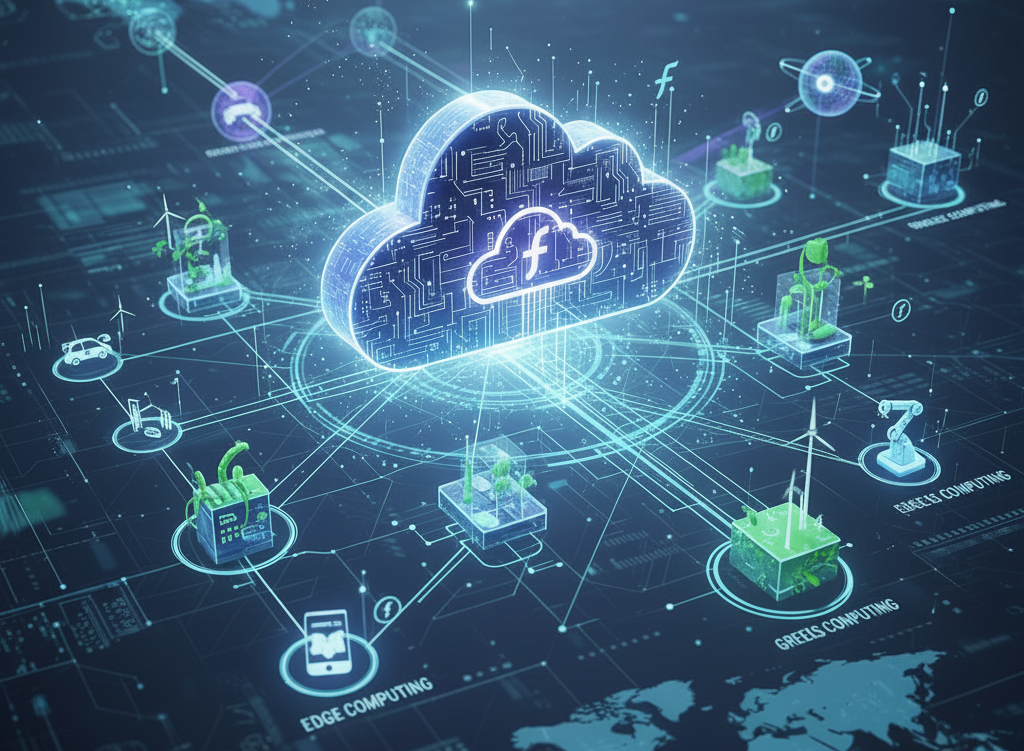
A decentralized (Edge), efficient (Serverless), and sustainable (Green Computing) ecosystem forms a distributed supercomputer—connecting cloud and edge seamlessly while reducing environmental impact.
Conclusion
Cloud computing is evolving—toward faster, greener, and more distributed systems.
- Edge Computing brings computation closer to users for real-time performance.
- Serverless and Green Computing reduce cost, complexity, and environmental impact.
This is the direction cloud technology is heading.